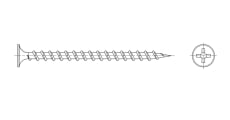
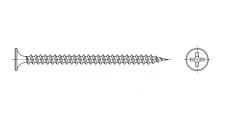
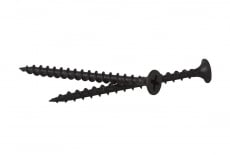
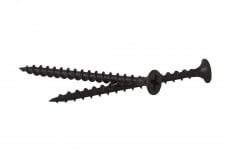
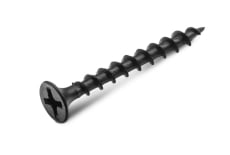
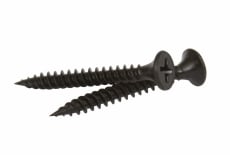
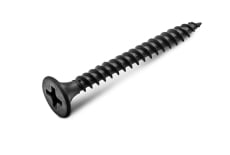
Self-tapping screws for plasterboard are specialised fasteners designed for fixing plasterboard panels to metal or wooden frames. They provide a strong and durable connection, and thanks to their special design, they penetrate the material easily without damaging the surface.
Hardened steel is used to manufacture these screws, ensuring high strength and load-bearing capacity. The countersunk head allows the fastener to be fully recessed into the plasterboard surface, creating a smooth base for subsequent filling and finishing.
A phosphate coating enhances corrosion protection, extends the service life of the products and improves the fasteners’ electrical insulation properties.
What are self-tapping screws for plasterboard?
Self-tapping screws for plasterboard are a type of fastener used to secure plasterboard sheets to stud frames. They feature a special thread, a sharp tip and a countersunk head, ensuring quick and reliable installation.
These self-tapping screws are widely used for:
- erecting partitions;
- installing suspended ceilings;
- cladding walls with plasterboard;
Features of self-tapping screws for plasterboard on metal
Self-tapping screws for plasterboard on metal are designed for fixing sheets to metal profiles. They feature a fine thread, which ensures a secure grip on the metal surface and prevents the fastener from loosening.
Key features:
- made from hardened steel;
- feature a countersunk head for flush installation;
- equipped with a sharp tip;
- have a phosphate coating for corrosion protection;
- suitable for the rapid installation of plasterboard systems.
These self-tapping screws are widely used in interior renovation and construction work where reliability and speed of installation are important.
Types and prices of plasterboard self-tapping screws
The catalogue features various types of self-tapping screws for plasterboard, depending on the type of substrate and conditions of use.
Wood screws have a coarser thread, making them easier to drive into wood. They are used for fixing plasterboard to wooden frames, as well as for assembling various wooden structures.
Metal screws are fitted with a fine thread for secure fastening in metal profiles. They are used when installing plasterboard systems with a metal frame.
The price of self-tapping screws for plasterboard depends on:
- length and diameter;
- type of thread;
- material;
- type of coating;
- packaging and order quantity.
How to choose and where to buy metal self-tapping screws for plasterboard?
When choosing self-tapping screws, it is important to consider the type of substrate, the thickness of the plasterboard and the operating conditions. For metal profiles, it is recommended to use self-tapping screws with a fine thread, and for wooden structures, those with a coarse thread.
You should also pay attention to:
- the quality of the steel;
- the type of coating;
- the sharpness of the tip;
- the precision of the thread;
- compliance with standards.
You can buy self-tapping screws for plasterboard wholesale and retail at the Dinmark online store. The catalogue features a wide selection of fasteners for professional and domestic use.
BENEFITS OF SHOPPING AT THE DINMARK B2B portal
The Dinmark online store offers a wide range of fasteners for construction, renovation and manufacturing.
Benefits of shopping with us:
1️⃣ a wide selection of self-tapping screws in various types and sizes;
2️⃣ high-quality products;
3️⃣ competitive prices for both wholesale and retail customers;
4️⃣ professional advice;
5️⃣ fast delivery across Ukraine;
6️⃣ popular items always in stock.
Questions and Answers
What is the difference between metal-cutting and wood-cutting self-tapping screws for plasterboard?
The main difference lies in the type of thread. Metal-cutting self-tapping screws have a fine thread for secure fastening to metal profiles, whilst wood-cutting self-tapping screws have a coarser thread that penetrates wood more easily.
What size self-tapping screws should I choose for plasterboard?
Self-tapping screws 25 mm in length are most commonly used for standard installation of a single layer of plasterboard. Longer versions are used for double layers or thicker structures.
How many self-tapping screws are needed per sheet of plasterboard?
On average, between 50 and 70 self-tapping screws are required to install a single sheet of plasterboard, depending on the type of structure and the fixing spacing.
Can standard self-tapping screws be used instead of those specifically designed for plasterboard?
The use of standard self-tapping screws is not recommended, as they may damage the material or fail to provide a sufficiently secure hold. Special self-tapping screws for plasterboard are designed specifically for this type of installation.
What length of self-tapping screw is suitable for single and double layers of plasterboard?
For a single layer of plasterboard, 25 mm self-tapping screws are usually used, and for a double layer, 35–45 mm, depending on the thickness of the structure and the type of frame.