

|
|
In Ukraine, amidst the war, the issue of fastening quality in military equipment is of particular importance.
The reliability of materials and the correct choice of bolt strength class directly affect the service life of the equipment, its stability and safe operation.
This applies to armoured vehicles, artillery systems, vehicles, drones and aircraft components, where fasteners operate under conditions of vibration, impact and variable loads.
In these conditions, a high-strength bolt cannot be considered a secondary component, as the reliability of the entire assembly depends on its quality and compliance with design requirements. |
High-strength bolts in military equipment: why strength class is just the beginning?
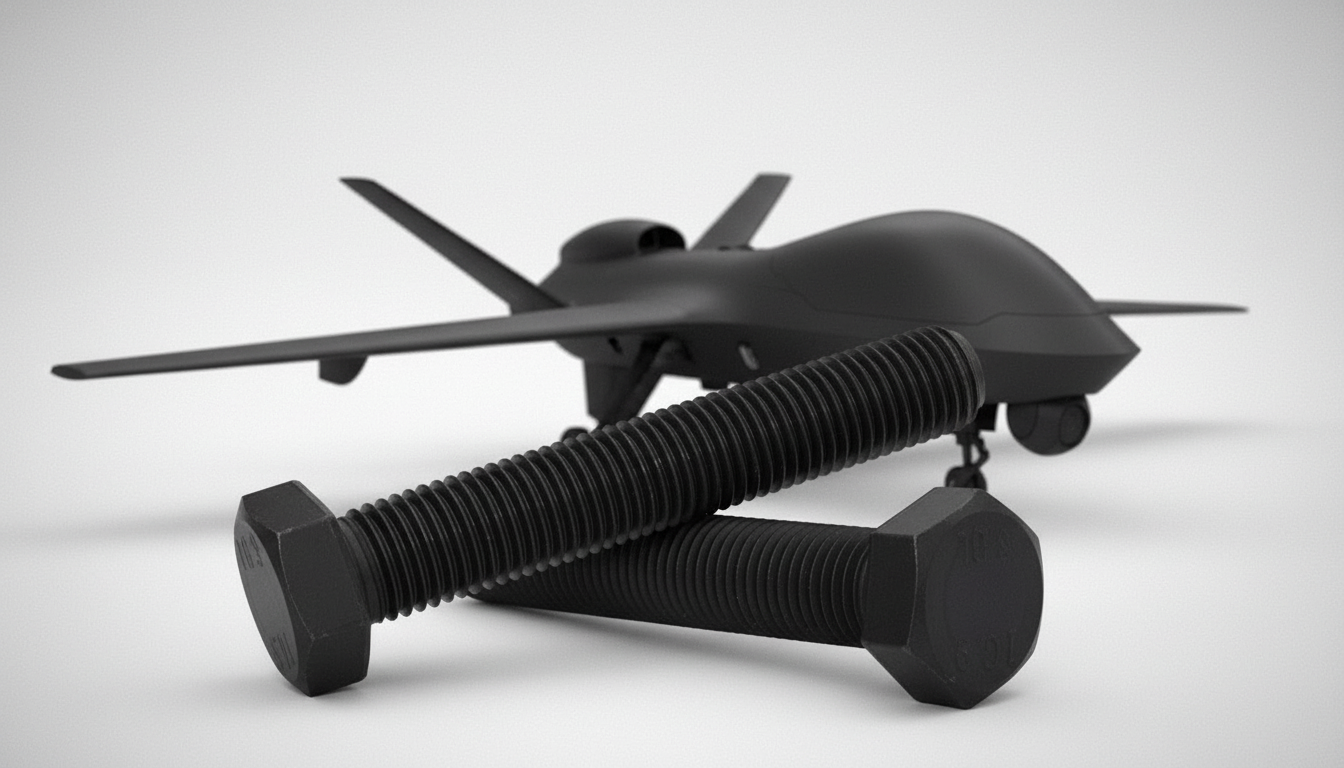
High-strength bolts in military equipment are used in assemblies where the fastener operates under constant vibration, shock and variable loads, temperature changes, exposure to moisture, dust or dirt. In such conditions, the reliability of the connection depends not only on the strength class of the bolt, but also on the correct selection of the entire fastening assembly: nuts, washers, coating, tightening method and installation control.
That is why fasteners for military equipment are selected based on the needs of a specific assembly, the nature of the load, requirements for pre-tensioning, coating and installation stability.
Differences between bolt strength classes
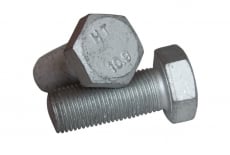
The marking on the bolt head determines its mechanical capabilities and permissible operating limits. According to the ISO 898-1 standard, these numbers indicate specific parameters of the strength of the metal.
What do the first and second numbers in the bolt marking mean?
- The first number (10 or 12): indicates the ultimate tensile strength. The higher this number, the greater the tensile force the bolt can withstand until it breaks.
- The second number (9): determines the yield strength. This is an indicator that the bolt retains its original shape and elasticity almost until the breaking point is reached (at 90% of the maximum strength).
Class 10.9 - medium strength
This is one of the main types of fasteners for power connections, where high load-bearing capacity and stable tightening are required. The minimum ultimate strength of such a bolt is 1040 MPa, and the conditional yield strength is 940 MPa. In practice, bolts of this class are often used in connections where it is important to ensure the stability of the connection and a high initial tension that can withstand operating vibrations and variable loads.
Class 12.9 – maximum loads
It is used in more loaded connections, where higher strength is required with the same fastener diameter or when the design limits the possibility of using a larger bolt. The minimum tensile strength for bolts of this class is 1220 MPa, and the conditional yield strength is 1100 MPa. At the same time, the use of this class is advisable only where it is confirmed by calculation or requirements for the node, since an increase in the strength class in itself does not guarantee greater reliability of the connection.
In which nodes of military equipment are bolts 10.9 and 12.9 used
In military equipment, the choice between strength classes depends on the functional purpose of the connection. The bolt must not only fix the parts, but also maintain the initial tension for a long time under conditions of shock, vibration, cyclic loads and sudden temperature changes. For such assemblies, the entire system is critical: bolt, nut, washer, type of coating, presence of lubricant and tightening method. High-strength preload systems are considered as a single mechanism, where each component affects the overall stability of the structure.
Bolts in power and transmission assemblies of military equipment
In engines, gearboxes, power unit supports and rigid frame joints, the main task of the fastener is to maintain the clamping force during long-term operation of the machine. In such assemblies, grade 10.9 is often the main solution, while grade 12.9 is used in cases of high local loads or a shortage of installation space, when it is necessary to provide a higher load-bearing capacity without increasing the diameter of the bolt. For such connections, the correct preload, quality of the contact surfaces, type of coating, condition of the thread and compliance with the requirements for the tightening moment are critically important.
Fastening of armor elements, frames, supports and power brackets
During the installation of protection panels, support nodes and power brackets, the bolted connection operates under conditions of micro-movements, local shocks and alternating loads. In such nodes, it is important to ensure the predicted behavior of the fastening during tightening and in operation so that the connection does not lose tension and does not lead to breaking holes or weakening of the joint. If the design is designed for class 10.9, replacing it with 12.9 without checking the entire node is not always an advantage, since the higher hardness of the material does not guarantee the geometry of the joint, installation and load regime.
Which nodes in military equipment are considered critical for choosing the maximum strength class?
Critical nodes are considered nodes in which the loss of clamping force, bolt breakage or weakening of the joint can affect the operability of the system, the accuracy of the relative position of the parts or the safe transfer of load. In such cases, it is important not only to choose the strength class, but also to control the origin of the fastener, the compatibility of all elements of the kit and compliance with the established installation technology. For critical connections, the bolt, nut, washer and coating should be considered as a single system, on which the reliability of the assembly as a whole depends.
Application of bolts in different classes of military equipment
The areas of application of high-strength bolts cover all classes of specialized machines. The harsher the conditions and the more sensitive the assembly is to the loss of clamping force, the stricter the requirements for the strength class, anti-corrosion coating and method of fixation.
Critical components of military machines where high-strength fasteners are required
Such components include frames, power unit supports, rigid mounting joints, power brackets and other connections operating under cyclic or shock loads. In most cases, grade 10.9 covers the basic needs of power engineering, providing the necessary balance between strength, tension stability and operational reliability. Grade 12.9 is used where the design requires greater load-bearing capacity with a limited bolt diameter or under increased local loads.
Application of bolts in armored vehicles and tanks
In armored vehicles and tanks, high-strength fasteners are used in hull elements, auxiliary power units, equipment brackets, unit supports and other connections operating under constant vibration, shock loads and variable loads. For such conditions, not only the mechanical characteristics of the bolt are important, but also the stiffness of the joint, the correct tightening torque, the condition of the supporting surfaces, the corrosion resistance of the coating and the compatibility of all components of the fastening kit. In heavy tracked vehicles, this is especially important, since loss of tension in the power unit leads to accelerated wear of parts, deformation of the joint or damage to the seats.
Application of bolts in UAVs
In modern warfare, UAVs have become one of the most important types of military equipment, so the requirements for their design, weight and reliability are constantly increasing. For unmanned systems, weight is of great importance: the lighter the design while maintaining the necessary strength, the greater the useful load capacity, flight duration or energy reserve can be. This is where high-strength fasteners provide an important engineering advantage. By strengthening the connection in some places, you can make the fastening lighter or avoid using bolts of larger diameter. This allows you to make the design lighter without losing strength, which is very important for UAVs. It is important to consider not only the strength class of the drone, but also the material of the parts, the thickness of the elements, the presence of composites, the risk of thread breakage, local stresses and the influence of vibrations from engines or propeller groups.
Application of bolts in aviation
In aviation technology, very strict requirements are imposed on reliability, installation accuracy and resistance to fatigue loads. Just as in UAVs, the weight of the structure is of great importance. If it is possible to provide the necessary load-bearing capacity with the help of smaller or lighter fasteners, this directly affects the weight of the assembly and, therefore, its efficiency. However, specialized fastening systems and separate standards are often used in aviation, so it is incorrect to directly transfer the logic of choosing ordinary metric bolts of high strength classes here. For critical aviation connections, it is important to perform an accurate calculation of the assembly, check the fastening method, choose the right material and coating, and also reduce the risks of corrosion and hydrogen embrittlement.
Application of bolts in artillery
In artillery systems, bolted connections operate under the action of loads that arise during firing, as well as under the influence of repeated cycles of operation of mechanisms. For such nodes, it is important to ensure the stability of pre-tension, joint stiffness and sufficient fatigue strength of the fastening. The selection of bolts in such systems is carried out taking into account the nature of the load, the geometry of the node, installation conditions and requirements for the durability of the connection.
A presentation containing technical information on high-strength fasteners (10.9 and 12.9) used in military equipment:
Questions and answers about high-strength bolts in military activities
Can a 10.9 bolt be installed instead of a 12.9 bolt?
No, such a replacement is unacceptable without checking the calculation of the node. If the connection is designed for class 12.9, a 10.9 bolt under the same conditions may not provide the required safety margin or the required level of pre-tension. This can lead to plastic deformation of the fastener, loss of clamping force and a decrease in the reliability of the entire connection.
Why do 12.9 bolts sometimes fail faster than 10.9?
The reason usually lies not in the strength class itself, but in the operating conditions of the connection or installation violations. 12.9 bolts are sensitive to errors in the geometry of the joint, distortions, excessive local stresses, incorrect tightening and unsuccessful choice of coating. An additional risk factor may be hydrogen embrittlement if inappropriate processing or surface protection technologies are used for high-strength steel.
Which anti-corrosion coating should be chosen for operation in a humid environment?
For operation in a humid or corrosive environment, zinc flake and zinc flake black coatings are often used, as they can provide high corrosion resistance and are well suited for high-strength fastening. At the same time, the choice of coating should be made not only based on anti-corrosion properties, but also taking into account its effect on the coefficient of friction, tightening stability and the risk of hydrogen embrittlement. Therefore, the optimal solution is determined by the operating conditions of a particular unit, and not only by the type of environment.