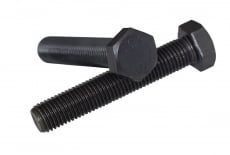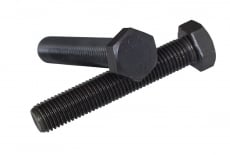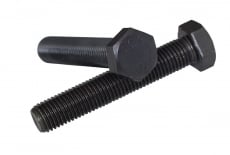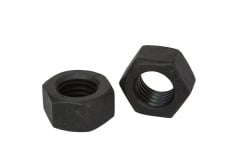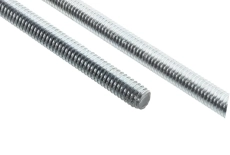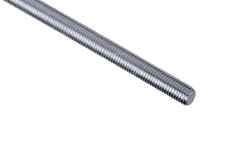


Inch thread
Inch thread is a type of thread whose parameters are expressed in inches (the inch designation on the drawing is indicated by quotation marks after the number 1" = 2.54 cm, and the profile angle is 55°. This thread is also known as American thread, as it is used as the national standard in the United States.
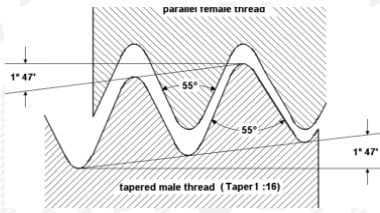
There are not many differences between them in terms of external characteristics, but those that are really worth paying attention to include:
- The shape of the thread profile of the crest;
- The procedure for calculating the diameter and pitch.
If we compare the shapes of the ridges, it is immediately apparent that they are sharper in inch threads; to be precise, the angle at the top is 55°. Other parameters are also characterized by different units of measurement. The diameter, length, and pitch of metric threads are measured in millimeters, while inch threads are measured in inches. It should be noted that a special pipe inch equal to 3.324 is used for inch threads, rather than the standard inch (2.54 cm).
For reference materials (diameter, number of threads per inch, thread pitch, etc.), see the bottom of the Inch Fasteners page.
Tightening torque for fasteners with inch threads
|
Thread size, inches |
Tightening torque |
|
|
N*m |
Pound-force foot |
|
1/4 |
12±3 |
9±2 |
5/16 |
25±6 |
18±4,5 |
3/8 |
47±9 |
35±7 |
7/16 |
70±15 |
50±11 |
1/2 |
105±20 |
75±15 |
9/16 |
160±30 |
120±20 |
5/8 |
215±40 |
160±30 |
3/4 |
370±50 |
275±37 |
7/8 |
620±80 |
460±60 |
1 |
900±100 |
660±75 |
11/8 |
1300±150 |
950±100 |
1 1/4 |
1800±200 |
1325±150 |
1 3/8 |
2400±300 |
1800±225 |
1 1/2 |
3100±350 |
2300±250 |
1 N*m equals 0.1 kgm
A pound-force foot is a British and American unit of measurement for N*m.
To tighten threaded connections in accordance with the table data, a special tool must be used—a torque wrench.
Types of inch threads
- Inch cylindrical thread - UTS (Unified Thread Standard). American inch thread is common in the United States and Canada. The angle at the top of this thread is 60°. Depending on the thread pitch, it is divided into: coarse - UNC (Unified Coarse); fine - UNF (Unified Fine); superfine - UNEF (Unified Extra Fine); 8UN; UNS (Unified Special).
- BSW (British Standard Whitworth) is a thread commonly used in the United Kingdom, known as Whitworth thread. Fine pitch thread is called BSF (British Standard Fine) - fine thread (Whitworth Fine Thread). Fine thread is designated as follows: BSF 1 ¼". The angle at the top of this thread is 55 degrees.
- Inch tapered NPT or cylindrical NPS. Complies with ANSI / ASME B1.20.1. This thread is used for pipe connections. It has an angle at the top of 60 degrees.
Thread pitch of inch fasteners
The pitch, in inch threads, is the number of turns per inch and is abbreviated as TPI.
The thread designation indicates its diameter D, followed by the TPI (number of threads per inch) and its type UNC or UNF. For diameters less than ¼", the size is determined by an integer from 0 to 12, which follows the symbol # or №. Each number corresponds to a specific diameter size, the exact value of which can be found in the reference table.
How to determine the thread pitch of an inch fastener:
- Using a thread gauge. This is a tool consisting of special plates, one side of which has protrusions that help determine the thread pitch. There are different tools for metric and inch threads. They can be distinguished by the degree markings on one - 60, on the other - 55.
- Using a ruler. Determine the total length of the fastener thread and count the number of turns in this section. Then divide the length by the number of turns.
- Using a caliper. Measure the total length of the thread and count the number of turns in this section. Then divide the length by the number of turns. This method differs from the previous one only in that it is more accurate.
- Using a table. Knowing the diameter, you can easily determine the thread pitch using a table.
Strength class of bolts with inch thread
Inch fasteners have much more complex markings than metric fasteners. Without expert tables, it is impossible to accurately determine the mechanical properties of a fastener. Inch fasteners of various types and sizes can be purchased in our online store.
The most common markings are found on the heads of inch bolts. Their correspondence to the strength classes we are familiar with is shown in the table below:
|
SAE strength class |
Strength class of replacement bolt (not lower than) |
|
1 |
6,8 |
|
2 |
6,8 |
|
5 |
8,8 |
|
6 |
10,9 |
In addition, the strength class of an inch-threaded product can be determined by the number of lines:
|
For bolts |
For nuts |
.png) |
|
.png)
Find out more in our expert video: