

Fastening armoured vehicle components under conditions of constant vibration
Modern armoured vehicles operate under conditions of constant dynamic loads, sudden impacts, temperature fluctuations and regular maintenance. Under such conditions, even a slight loosening of a fastening can affect the stability of the assembly, cause parts to shift or lead to accelerated wear of structural components. This is precisely why military fastenings for armoured vehicles must ensure not only strength but also stable fixation during operation.
Particular attention must be paid to assemblies subject to high vibration and shock loads. If nuts or washers are incorrectly selected, the clamping force gradually decreases, self-loosening occurs, and threaded connections lose their stability. This is critical for armoured vehicles, as they operate intensively and undergo repair, reassembly and operation in field conditions
Vibration-resistant nuts and washers for armoured vehicles
It is a mistake to assess a nut in isolation from the bolt, or to select a washer without taking into account the condition of the bearing surface and the nature of the load.
To ensure a reliable connection, the following must be taken into account:
- the bolt’s strength class;
- the tightening torque;
- the type of load;
- the presence of transverse displacements;
- the temperature in the operating area;
- the conditions for disassembly and reassembly;
- the risk of parts settling after assembly.
Vibration loads in armoured vehicles can be constant or variable, so standard nuts are often insufficient in many assemblies.
For critical assemblies, the following are most commonly used:
- self-locking nuts;
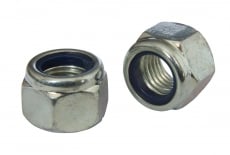
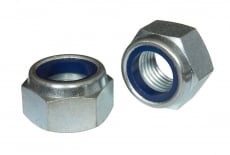
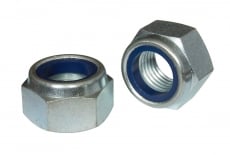
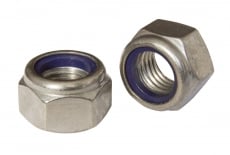
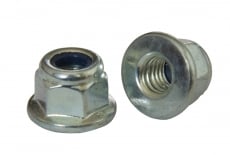
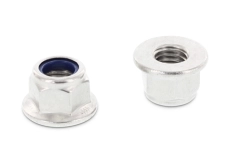
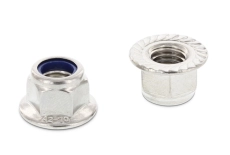
- nuts with a polymer insert;
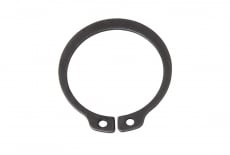
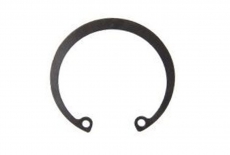
- lock washers;
- conical spring washers;
Self-locking nuts are best used in assemblies subject to high temperatures and severe vibration. They are well suited to areas where fasteners are regularly removed during servicing or repairs.
Nuts with a polymer insert should only be used within the permissible temperature range. If the polymer loses its properties due to heat, the fastening’s hold deteriorates and the assembly loses stability more quickly.
It is also important to mention common mistakes made when selecting fasteners for armoured vehicles.
The following factors often lead to self-loosening:
- the use of standard nuts in assemblies subject to high vibration loads;
- incorrect selection of washers for a specific type of load;
- a washer that does not match the bolt’s strength class;
- the reuse of damaged locking elements;
- insufficient control of the tightening torque;
- the use of nuts with polymer inserts in overheated assemblies.
It is precisely because of such errors that fastening assemblies can gradually lose stability even when installed correctly.
Where fasteners with enhanced vibration resistance are required in armoured vehicles
Fasteners operate under different conditions in various parts of an armoured vehicle. Therefore, for each assembly, it is necessary to take into account the nature of the load, temperature, service access and the risk of loosening.
 |
Nuts and washers for the running gearThe running gear operates under some of the most severe operating conditions. Fastening assemblies are constantly subjected to heavy impact loads, suspension oscillations, dynamic load changes and vibration when travelling off-road. This is precisely why it is important to use fasteners with anti-loosening protection for the running gear. If transverse displacement of parts is possible in the joint, standard fasteners do not provide sufficient stability. For such assemblies, it is advisable to use: Such solutions help maintain the reliability of the joint even under severe vibration loads and during prolonged operation of the vehicle. |
Threaded connections in the engine compartment
The engine compartment of armoured vehicles operates under conditions of high temperature, constant vibration and contact with lubricants. Furthermore, many assemblies are regularly dismantled during the maintenance or repair of armoured vehicles.
In such conditions, threaded connections must not only withstand mechanical loads but also maintain a secure hold after reassembly.
For hot areas of the engine compartment, self-locking nuts are the optimal solution; however, those with a polymer insert should only be used where temperatures do not exceed the permissible limits.
For certain components in the engine compartment, it is also important to compensate for component settlement after installation. This is why DIN 6796 is often used in such locations.
Fastening of equipment, hatches, panels and internal modules of an armoured vehicle
The body components of an armoured vehicle operate under slightly different conditions than the chassis or engine compartment. The loads here are lower, but the requirements for fastening stability remain high.
Hatches, panels, internal modules, instrument clusters and other equipment must maintain a reliable connection even after repeated opening and reinstallation.
When selecting fasteners for such assemblies, the following must be taken into account:
- material stiffness;
- the presence of paint or coating;
- the shape of the holes;
- the condition of the mounting surface;
- the frequency of removal.
If the housing components are subject to vibration and there is a risk of parts shifting, it is advisable to use washers with a locking function or with an increased outer diameter to ensure correct load distribution.
What types of self-locking nuts are suitable for use on armoured vehicles
For armoured vehicles, it is important to use nuts that ensure a secure hold even after prolonged vibration and repeated servicing.
The following types are most commonly used:
Self-locking nuts
Suitable for assemblies subject to high temperatures, severe vibration and frequent servicing. They perform well in the engine compartment and running gear assemblies.
Nuts with a polymer insert
Effective for assemblies with moderate temperatures. The polymer provides additional resistance to loosening, but may lose its properties if overheated.
High-strength nuts for critical assemblies
For certain assemblies on armoured vehicles, high-strength nuts are used in combination with lock washers. This solution enhances the reliability of fastening assemblies and ensures stable operation of the equipment in field conditions.
Which washers help maintain tightness under impact loads
In assemblies subject to heavy impact loads and constant vibration, the washer plays a role that is no less important than the nut itself.
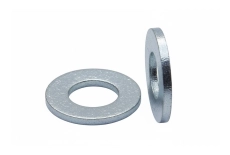
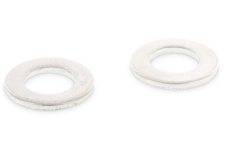
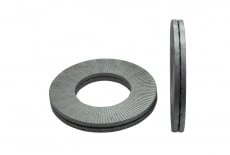
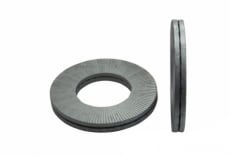
Lock washers
One of the most effective solutions for assemblies with high vibration loads. Their operating principle is based on a wedge effect that counteracts self-loosening. As a result, they function even in the presence of lubricant, remain effective under strong vibrations, provide additional protection against loosening, and are well suited for critical assemblies in armoured vehicles.
With notches
Used in assemblies with high clamping forces and high-strength bolts. Their effectiveness depends on the condition and hardness of the supporting surface.
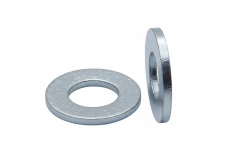
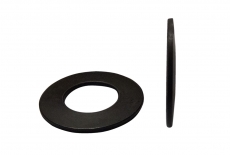
Conical spring washers DIN 6796
Used to compensate for loss of clamping force due to component settlement after assembly. They help maintain a stable clamping force during operation.
At the same time, it is important to understand that conical spring washers do not replace lock washers in assemblies subject to strong transverse vibration.
What to consider when selecting fasteners for armoured vehicles
The selection of fasteners for armoured vehicles must take into account the actual operating conditions of the assembly. To do this, it is necessary to assess not only the type of fastener, but the entire connection system.
Before making a choice, the following should be taken into account:
- the temperature in the operating area;
- the nature of the load;
- the bolt’s strength class;
- the possibility of transverse displacement of parts;
- the risk of settlement after installation;
- the frequency of maintenance;
- the operating conditions of the equipment in the field.
If the assembly operates in a high-temperature environment, it is better to use self-locking nuts. If there are strong vibrational loads, it is advisable to use lock washers.
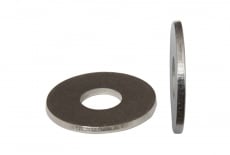
It is also important to check that the washer corresponds to the bolt’s strength class. Incorrectly selected components can lead to damage to the bearing surface, loss of clamping force and reduced stability of the assembly.
For armoured vehicles, it is particularly important to take into account future repairs and re-assembly. Some types of nuts and washers must be replaced with new ones after removal.
Questions and Answers
Are self-locking nuts suitable for the engine compartment?
Yes, but for hot areas of the engine compartment, it is advisable to use self-locking nuts; those with a polymer insert are best reserved for assemblies with lower temperatures.
Which washers are best for armoured vehicle body joints?
For assemblies subject to heavy vibration, lock washers are optimal. If the main objective is to compensate for component settlement, it is better to use conical spring washers.
Can lock washers be reused after removal?
This depends on the type of product and its condition. Before reinstallation, the washer must be checked for deformation, wear and damage to the working surfaces. If the component has lost its properties, it must be replaced.
How can you tell if a fastening is failing to withstand operational loads?
Typical signs of fastening problems:
- the connection needs to be retightened regularly;
- there are visible signs of misalignment on the parts;
- play develops;
- the clamping force decreases rapidly;
- the bearing surfaces wear out.
Such signs indicate that the fastening assembly or its individual components have been selected incorrectly.